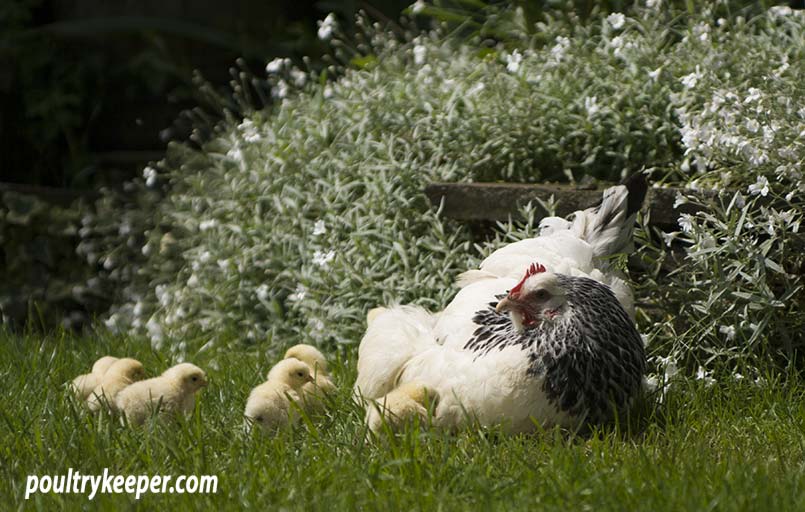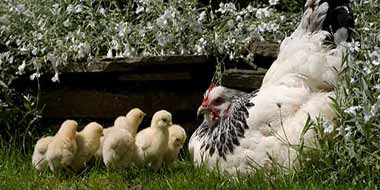

Using a broody hen to incubate eggs and hatch chicks, the way Mother Nature intended, has many benefits since she will usually hatch and rear the chicks without needing much assistance.
In this article, I will look at what to do with a broody hen during the first few days of broodiness, getting a broody coop set up, answering how many eggs she can cover, and giving some tips for hatching eggs under a broody hen.
If your hen already has chicks, then you might want to skip to the next article from our Broody Hen Advice: Broody Hen Care which deals with caring for her and her chicks after they hatch.
Broody Hen Advice:
- Hatching Eggs with a Broody Hen (this article) - What to do if you want to use a broody hen to hatch some fertile eggs.
- Broody Hen Care - How to care for a broody hen once she has her chicks.
- How to Stop a Broody Hen - We don't always want broodiness. Tips for breaking a broody hen.
Not all hens will go broody, and some are much better at sitting on eggs and mothering chicks than others. Light and flighty breeds won’t usually go broody, and if they do, they don’t typically make great mothers.
Utility breeds rarely go broody. It has been selectively bred out of them: they are not laying eggs when they are broody!
I’ve mostly owned utility breeds during my time keeping chickens, and I’ve had my fair share of disappointments. Some hens have left their eggs partway through incubation; others have carelessly trampled or even pecked their chicks.
Saying this, I have also kept a few breeds of chickens prone to going broody, and if you get “a good sitter”, then, given a suitable place to sit, she will often be more successful than any egg incubator you can buy.
What is a broody hen?
During the spring and summer months, when the day length increases and there is no food shortage, some (but not all) hens go broody.
A hormone called prolactin causes broodiness. The pituitary gland, situated just behind the eye, releases prolactin. It also releases hormones that cause egg-laying according to the number of daylight hours.
- Chickens Stop laying in Winter – Why chickens stop laying during the winter months.
I’m sure you’ve heard of the saying “feeling broody” when prolactin is released: She has the urge to sit on some eggs, hatch them and become a mother.
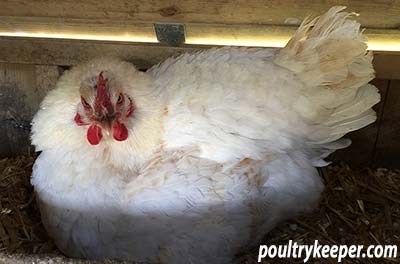
She will lose feathers on her breast (this is called a broody patch) so that she can make contact with her eggs to keep them warm.
A broody hen takes care of the temperature and humidity of her eggs as well as the egg-turning. When the eggs hatch, the chicks are kept warm and shown what’s good to eat.
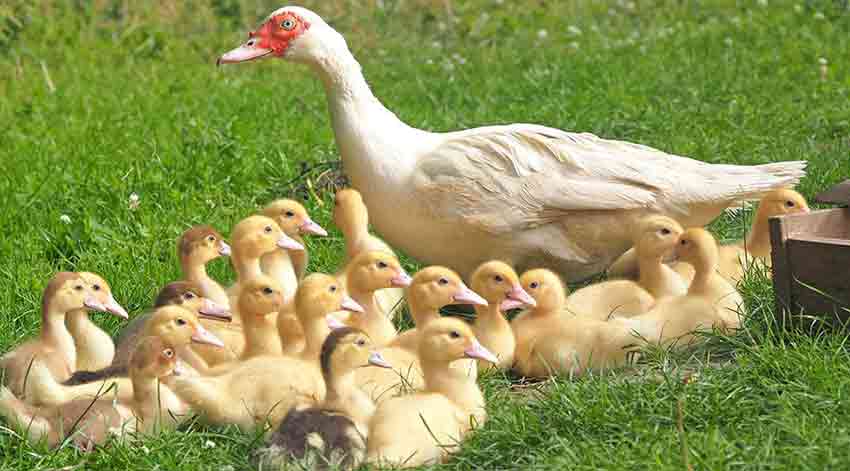
Some breeders (especially waterfowl breeders) will keep a breed known for broodiness and let them take care of all the incubating and hatching. Of course, you don’t need to use the same breed or even species to hatch eggs, and there are many mother hens each year, confused by her broods’ love of water, and that’s because they are, in fact, ducklings she’s hatched!
What are the signs of a broody hen?
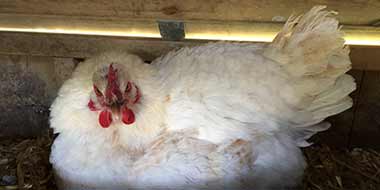
When a hen is broody, she will refuse to leave the nestbox and return to it when removed.
She will become protective, so when you put a hand near, you will hear her an unhappy scolding sound: a ‘don’t touch me’ warning.
She will puff up her feathers and give your hand an almighty peck if you get close to her.
Clucking is also a sign of a broody hen.
What to do with a broody hen?
Broodiness may be welcome or unwelcome. This article tells you what to do with a broody hen to hatch fertile eggs; however, it’s worth mentioning that if the timing is wrong or you don’t think your hen will sit the term, you may want to stop her, and this is kinder because it will stop her from running herself down. You have three options:
- Stop her broodiness: You can break her broodiness, but the longer she is broody, the more determined she will become, so it’s best to act quickly. See this article: How to Stop a Broody Hen for more information on how to break her broodiness.
- Leave her. However, she can be a nuisance in the hen-house. She will keep sitting on eggs your other hens have laid, and that will start incubation if they are fertile. While she is broody, she won’t lay eggs. Broody hens eat less, so lose weight and condition. They are also a target for red mite. I don’t recommend leaving a broody hen.
- Give her some fertile eggs to hatch. Once you’re sure she’s determined, she can be settled to sit on some fertile eggs to hatch some chicks. If you want to do this, then read on!
How many eggs can a broody hen cover?
Large breeds, such as the Australorp or Cochin, can cover up to a dozen medium-size eggs; however, the more eggs she has, the more likely she will break some of them.
Bantams can sit on large eggs, but being smaller, they can’t cover as many of them. I don’t usually give them many more than half a dozen eggs—eight at the most.
Some of the larger duck breeds (like the Muscovy) can cover almost two dozen eggs.
I place a reasonable number of eggs underneath a broody and see whether she manages to keep them all covered in the first 12 hours. If not, I remove a couple.
Broodiness
How to make a hen broody?
Unfortunately, you can’t make a hen go broody. All you can do is leave some eggs to accumulate in the nest to encourage broodiness. Even better than this is to leave some dummy eggs in a nestbox; otherwise, you may end up with broken eggs.
A hens’ maternal instincts are strongest in the spring and summer months.
You can get a good idea of whether a hen will likely go broody by her breed.
Any hen can go broody, but some breeds are much more prone to broodiness than others.
By far, the best sitters are Silkies and Silkie-crosses. They are dedicated and also make excellent mothers. Still, some say their feathers (which look more like fur) can get tangled around the chicks, so they prefer to cross them with other breeds. Then, they have normal feathers but still maintain their mothering instincts.
Here is a list of breeds that are most likely to go broody with links to our breed pages if you want to learn more:
The duck breeds that are most likely to go broody are:
When a hen does go broody, you can’t tell how good she will be at it. Most pullets (female chickens under a year old) are inexperienced and will stop sitting before they have hatched. The maternal instinct is more substantial in older hens (at least over a year old).
Once a hen has proven herself as a good broody, she is likely to be reliable again in the future.
Collection and storage of hatching eggs
It is essential to keep nest boxes clean. Collect hatching eggs as soon as you can so they don’t get soiled or broken by other hens in the house.
Store eggs pointed end down on trays or in egg boxes and find a cool place for them out of the sunlight.
Although it is tempting to try to hatch large eggs, the most viable are usually medium-sized. Do not use very pointed or round eggs since these can make hatching difficult.
When hatching eggs with a broody hen, we typically don’t need to store eggs for a long time because we need to get fertile hatching eggs under her after sitting for a few days.
If you would like to store eggs for longer than a few days, then I have written an article on this subject:
- How to collect and store hatching eggs – Hatching egg storage and the ideal conditions for keeping them over extended periods.
Hatching eggs with a broody hen
Moving a broody hen onto fertile eggs
When you notice the first signs of a hen going broody, please give her a couple of days to prove she’s determined. If she goes broody in the hen house where you collect fertile eggs, make sure she is not sitting on eggs that you want her to hatch at a later date, as this will start the incubation process too soon. Provide her with a couple of dummy eggs to sit on.
Tip: Dummy eggs
If you don't have any dummy eggs, golf balls make a good substitute, but if you still don't have these, you can use old eggs that are marked clearly with a pencil or marker pen so that they are not inadvertently collected.
Broody hen house specifications
A broody hen house is no more than a small coop with an attached run. Your hen will be quite happy sitting on the floor; it doesn’t need to have nest boxes. It ideally has the following features:
- Protection from predators as well as bad weather.
- Located in the shade during the hottest part of the day.
- It is separate from other poultry that may disrupt her.
- It has adequate ventilation.
- A grass-run for her to use once her chicks hatch.
- Somewhere quiet, away from other family pets.
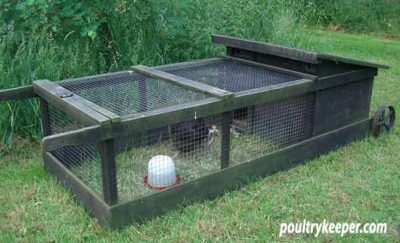
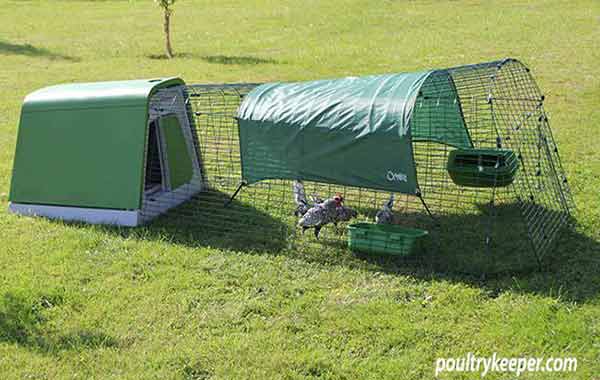
My favourite broody hen house was a very old wooden coop that was creosoted and stored away at the end of every summer; however, after using an Omlet Eglu Go for a few years, it has become my new favourite.
The Eglu Go is double-skinned, making it well insulated, and cleaning is straightforward because you can hose down the plastic floor trays which slide out.
You can learn more about this house on the Omlet website.
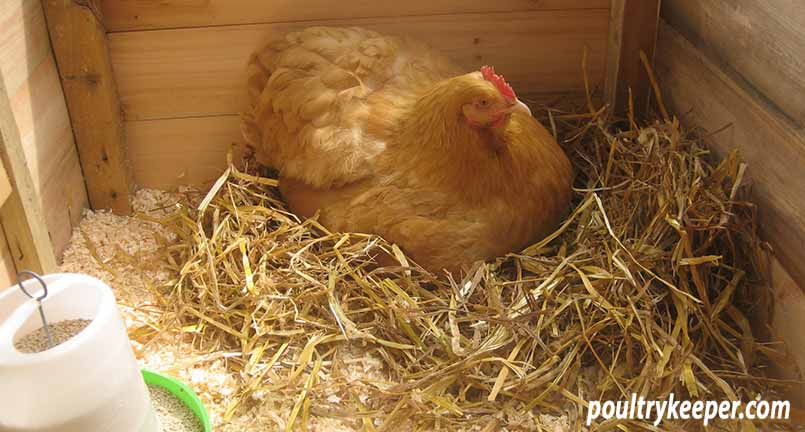
Inside your broody coop, place an upturned sod of grass or some damp earth as the base for a nest. Slope it up in the corners. The idea is to form a ‘saucer’ shape for the nest so that no eggs can roll out, but also it will help her provide much-needed humidity for her eggs. On top of the soil, build up a nest of clean, dry straw.
The Omlet Eglu also allows you to remove the floor entirely to build the nest directly on the ground. This does increase the risk of predators (such as rats) digging underneath, so exercise some caution with this.
Moving a broody hen
Settling her into new quarters
Waterfowl, turkeys, Guinea fowl and quail don’t like to be moved. They will also nest in some odd places and often give up if you try to move them, so it’s better to build some suitable nesting sites in advance to encourage them to use one of these.
Thankfully, chickens are relatively easy to move (with a little care)!
After a few days, you will know she is serious about brooding. When you are ready to settle her, take her to the quarters where she will hatch and look after her chicks. Provide her with some dummy eggs to sit on. I usually move my broody hens at dusk to keep disruption to a minimum.
Her coop and run should be situated in a quiet corner, away from disturbance. Keep it out of direct sunlight during the hottest part of the day, or she will overheat and find it challenging to keep the eggs at the correct temperature.
Once you have put her into the broody house, leave her alone to settle.
The following video clip is the slightly younger version of me in 2010, settling a broody bantam into a broody coop to sit on some duck eggs. She had been broody for three days beforehand but needed moving from the main chicken house away from the other hens so she could sit.
Red mite
Broody hens are a perfect feast for red mite. Your hen can die on the nest if you don’t take care of the mites quickly.
Before settling your broody hen, check for red mite in the coop and dust under her nest with diatom or a red mite powder. I always give her a good dusting with a mite/lice powder as well.
Keep an eye out for mites accumulating in cracks and crevices while she sits.
- The Ultimate Guide to Red Mite – My guide to red mite tells you how to get rid of red mite if you run into trouble with this ectoparasite.
Food and water
Keen hens do not get off to eat and drink. Some broody hens can even starve themselves to death; it depends on the breed and the individual hen, so you must give her a routine to follow for feeding, drinking and eliminating.
I lift my broody hens off at least once per day at the same time, placing them in front of food and water, but this should be available at all times so she can leave the nest for it if she likes.
Candling the eggs
When hatching eggs with a broody hen, she will take care of the incubation temperature, humidity and egg turning responsibilities. Even though most hens will get this right, it is still possible that some embryos will die and the eggs will rot, or there will be eggs that aren’t fertile.
Your broody hen will usually be able to tell if an egg is rotten, and she is likely to push it out of the nest; however, it’s an idea to candle the eggs.
Candling is where we shine a bright light through the eggshell in a darkened room to see whether the embryo is developing as expected.
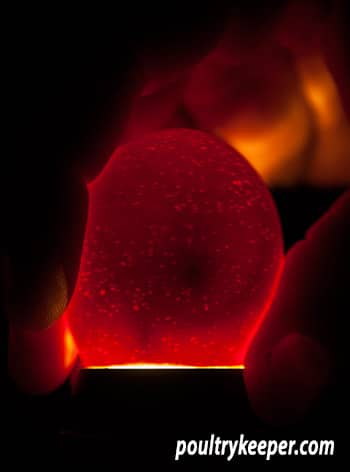
I recommend candling at least once on day 7 or 8 of incubation when it should be easy to remove any infertile eggs. You can take eggs gently from under her in small batches to candle them, mark them with a soft pencil so they don’t get taken twice and return them in the same way.
- Guide to candling eggs – This guide explains what you see when you candle eggs and includes many photos and video clips of the candling process at different stages.
How long can a broody hen leave her eggs?
It is normal for a broody hen to leave the nest to feed, drink and eliminate. She will eat and drink less than usual, and it is normal for them to lose weight and condition whilst sitting. For waterfowl, their time off the nest also includes time to bathe and preen.
Birds will usually sit tight and not leave the nest during the first couple of days of incubation. The first three days are the most critical, and it seems the hen knows this.
After the first few days, if she isn’t leaving the nest, you should remove her at least once each day.
The question of how long a broody hen can leave her eggs often comes up. It’s usually when she’s off the nest, and you find her eggs are cold and wonder if the eggs are still going to hatch.
There are two possibilities. If she has given up partway through incubation, you may be able to move eggs into an incubator, although don’t move them too quickly because sometimes hens will leave eggs for an extended time towards the end of incubation. The embryo produces its own heat during the later stages so that eggs can be left longer.
If you find cold eggs, leave them alone for another 30-40 minutes at least. The chances are she’s just taking a long break, and they should still hatch.
The pros and cons of using a broody
To conclude, hatching eggs with a broody hen has its advantages and disadvantages:
Pros:
- You don't have to worry about settings on an incubator or about turning eggs.
- You don't have to worry about power-cuts.
- The broody hen will generally hatch more eggs successfully than you will with an incubator.
- She will raise the chicks, keep them warm and guide them to food.
- She will usually keep them safe under her.
Cons:
- You don't always have a broody hen when you need one, or hatching eggs for the broody hen when you have one!
- You cannot hatch as many chicks under a broody hen as you can with some incubators.
- You need to provide a house and a run for a broody hen for a long time during the incubation and rearing process, even if you only hatch one chick.
- Not all broody hens are good at their job - some will tread on chicks accidentally or even turn on them and peck them, killing them.
So, hatching eggs with a broody hen certainly has some practical benefits, and she usually does a great job of hatching your eggs and raising the young.
Many wildfowl enthusiasts swear by them because hatching wildfowl eggs in an incubator is difficult at the best of times, and results aren’t usually that good.
I also think there is also something extraordinary about seeing chicks looking out from underneath Mother Hen. Although I have success with artificial incubation, I almost always hatch a sitting of eggs if I have a determined broody.
- Caring for a broody hen and her chicks – Once your broody hatches her chicks, Anne has some great tips on caring for her and her brood.