Goose Breeds

West-of-England-Cut-Out

Uses: Utility - meat and eggs. Useful autosexing characteristic.
Eggs: 20 to 50 white eggs per year.
Origin:
UK.
Weight: Gander: 7.3 - 9.1 Kg. Goose: 6.3 - 8.2 Kg.
Colour: Ganders: White. Geese: Pied Grey and White.
Useful to Know: An autosexing breed.
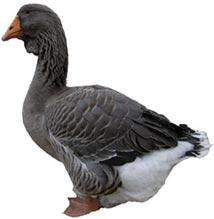
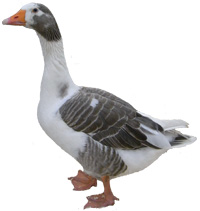
Photo: West of England Goose, BWA Best of Breed at the Poultry Club National 2009.

West of England Geese (like Pilgrim Geese) are an autosexing breed. These two breeds are the only true auto-sexing geese that can be sexed at hatch.

Ganders are white and geese are grey and white. Both goose and gander have a slightly pink-orange bill, legs and webs. The West of England Goose was first standardised in the UK in 1999.

Photos

View the embedded image gallery online at:
http://poultrykeeper.com/goose-breeds#sigProGalleria5c19bde705

Books

The following books are available. Links take you to the Amazon or other sellers' pages for the books.

Discussion

  • Comments / Questions? Looking for stock? Visit the Waterfowl Section of our Forum
  • Please leave us a comment below if you can provide further information on this breed.

toulouse-goose-cut-out

Uses: Utility - meat, especially when crossed with Embden Geese. As a broody although due to their size, can break their eggs.
Eggs: 20 to 40 white eggs per year.
Origin:
France.
Weight: Gander: 11.8-13.6Kg. Goose: 9.1-10.9Kg.
Colours: Grey, Buff and White
Useful to Know: A popular fast growing commercial hybrid is an Embden Gander crossed with Toulouse Geese. Dropped Tongue is common in Toulouse Geese.
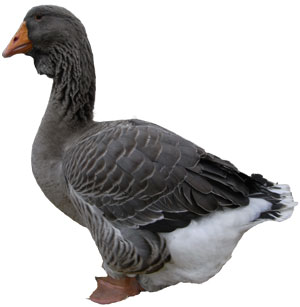
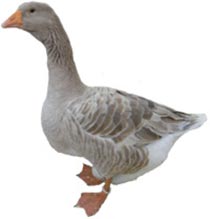
Photo: A German Toulouse Goose with a smaller keel than British / American exhibition varieties.

Toulouse Geese originate from the countryside around the city of Toulouse in Southern France. The French created this incredibly heavy goose to use for 'Pâté de foie gras'. This has been, and still is, a delicacy in France. Forced feeding used in the production of foie gras production is controversial, due to the procedure of forcing a tube down the throat and the health consequences of an enlarged liver. A number of countries now have laws against the sale of foie gras and the force feeding of animals. It was the British and American breeders that increased the size and dewlap of the Toulouse Goose even further. German Toulouse have smaller keels than British Toulouse.

The Grey Toulouse Goose (together with the Embden Goose) was one of the first Geese to be standardised in 1865 in the UK. The White version was standardised in 1982 and the Buff in 1997. In France they are called L'oie du Toulouse and in Germany Toulouser Gänse.

Photos

View the embedded image gallery online at:
http://poultrykeeper.com/goose-breeds#sigProGalleria74f9c272bc

Books

The following books are available. Links take you to the Amazon or other sellers' pages for the books.

Discussion

  • Comments / Questions? Looking for stock? Visit the Waterfowl Section of our Forum
  • Please leave us a comment below if you can provide further information on this breed.

Steinbacher-cut-out

Uses: Utility - Meat & eggs. Eggs: 30 to 50 white eggs per year.
Origin:
Germany.
Weight: Gander: 6 - 7 Kg. Goose: 5 - 6 Kg.
Colours: Blue, Grey (standardised), Cream and Buff (non standardised)
Useful to Know: Some strains can be aggressive. The Steinbacher was after all named 'the fighting goose' in France and Germany.
Photo: Steinbacher Gander. Photo courtesy of Rupert Stephenson.

Steinbacher Geese are small, light weight, proud looking geese that look similar to Russian Fighting Geese. Steinbacher Geese came from the Thuringia region in eastern Germany and were originally bred from a cross from the local, regional geese and Chinese Geese. Their most distinctive feature is the orange bill with a black bean. They have orange legs and feet. In France, they are called L'oie de combat de Steinbach or "The Steinbacher Fighting Goose". In Germany, they are called Steinbacher Kampfgänse. Kampfgänse also means "fighting Goose". Steinbacher Geese were first standardised in the UK in 1997.

Photos

View the embedded image gallery online at:
http://poultrykeeper.com/goose-breeds#sigProGalleria0347075353

Books

The following books are available. Links take you to the Amazon or other sellers' pages for the books.

Discussion

  • Comments / Questions? Looking for stock? Visit the Waterfowl Section of our Forum
  • Please leave us a comment below if you can provide further information on this breed.

sebastapol-cut-out

Uses: Showing / Attractive unusual pets. Eggs: 30 to 50 white eggs per year.
Origin:
Eastern Europe.
Weight: Gander: 5.7 - 7 Kg. Goose: 4.5 - 6 Kg.
Colours: Buff, White. (Curled feather and smooth breasted varieties)
Useful to Know: Light Grey feathers can appear in white females during their first year.
Photo: A White Smooth Breasted Sebastopol.

Sebastopol Geese were originally from the River Danube near the Black Sea and have been called the Danubian goose. They are known as Lockengänse in Germany and L'Oie Frisse in France. Sebastopol Geese are medium weight geese, known for their long curled 'frizzled' feathers that make flight almost impossible for them. They have striking blue eyes. There are two types standardised in the UK, the Buff and White varieties although grey and saddle backed varieties exist. There are two types - smooth feathered and curled feathered. Because of their rough feathering, they are not so waterproofed as other geese and do require a shelter to be able to get out of the worst of the weather. Sebastopols are not known as an aggressive breed and they will go broody and sit on eggs.

Photos

View the embedded image gallery online at:
http://poultrykeeper.com/goose-breeds#sigProGalleria7a021a7894

Books

The following books are available. Links take you to the Amazon or other sellers' pages for the books.

Discussion

  • Comments / Questions? Looking for stock? Visit the Waterfowl Section of our Forum
  • Please leave us a comment below if you can provide further information on this breed.

Roman-Goose-Cut-Out

Uses: Utility - good meat to bone ratio. Eggs: 40 to 60 white eggs per year.
Origin:
Germany / Poland.
Weight: Gander: 5.4 - 6.3 Kg. Goose: 4.5 - 5.4 Kg.
Colours: White.
Useful to Know: Occasionally, the odd grey patch can appear in offspring. This is a fault, although light grey feathers on the back and rump in first year females will fade and is permitted.
Photo: Roman Goose owned by Mrs Erica Hughes. Photo Courtesy of Rupert Stephenson.

Roman Geese are small chubby white geese with a short neck that carry a large amount of meat on them. They are slightly bigger than Czech Geese and slightly smaller than Diepholtz Geese. They are originally believed to have come from selected strains of Italian geese created as far back as 350BC during Roman times.

Roman Geese were imported into the UK during the early 1900's. They have light blue eyes and orange to pink bill and webs / feet. Some Roman Geese are tufted. Both tufted and non-tufted can be shown in the UK although the American Poultry Association Standard requires a tuft.

The temperament of the Roman Goose can vary although as with all geese, their upbringing has a fairly large part to play in this.

Photos

View the embedded image gallery online at:
http://poultrykeeper.com/goose-breeds#sigProGalleriaafcf5960ec

Books

The following books are available. Links take you to the Amazon or other sellers' pages for the books.

Discussion

  • Comments / Questions? Looking for stock? Visit the Waterfowl Section of our Forum
  • Please leave us a comment below if you can provide further information on this breed.

Pomeranian-Gander-Cut-Out

Uses: Utility - traditionally breast meat. Eggs: 35 to 70 white eggs per year.
Origin:
Germany / Poland.
Weight: Gander: 8.2 - 10.9 Kg. Goose:  7.3 - 9.1 Kg.
Colours: Ganders: White, a little grey. Geese: Light Grey.
Useful to Know: Must have a single lobed paunch.
Photo: A Pied Grey Pomeranian Gander.

Pomeranian Geese were traditionally bred to have a large amount of breast meat on them. They were used for delicacies like smoked goose breast in their native region of Pomerania in the Northern part of Germany, bordering with Poland. It is probable that the modern Pomeranian Goose does not have the same shape. In Germany, Pomeranian Geese can be found in Grey, Pied Buff, Pied Grey, and White. The Pomeranian Goose has blue eyes and has been specifically bred to have a single-lobed paunch. Dual lobed birds are usually Grey Back Geese. Exhibiting them with a dual lobed paunch will usually result in a disqualification. Some strains of Pomeranian Goose are good layers and can lay up to 70 eggs in a season although most exhibition strains lay half of this amount.

Pomeranian Geese were standardised in 1982 in the UK. They are called L'Oie de Poméranie in France and Pommerngans in Germany.

Photos

View the embedded image gallery online at:
http://poultrykeeper.com/goose-breeds#sigProGalleriaee2d062a8e

Books

The following books are available. Links take you to the Amazon or other sellers' pages for the books.

Discussion

  • Comments / Questions? Looking for stock? Visit the Waterfowl Section of our Forum
  • Please leave us a comment below if you can provide further information on this breed.

pilgrim-cut-out

Uses: Utility - meat, relatively fast growing. Eggs: 20 to 40 white eggs per year.
Origin:
UK.
Weight: Gander: 6.3 - 8.2 Kg. Goose:  5.4 - 7.3 Kg.
Colours: Ganders: White, a little grey. Geese: Light Grey.
Useful to Know: Most Pilgrim Geese are very tame if hand reared and have good parenting qualities. For breeding, birds should be selected for correct autosexing and the gentle nature that they are known for. The ganders are charming and attentive to their geese. During the breeding season in spring to early summer they can demonstrate particularly protective behaviour. This is really a lot of bluff that ceases when he moults.
Photo: Colin Murton's Champion Pilgrim Goose.

Pilgrim Geese are relatively quiet, light weight geese that are one of only two autosexing breeds of geese standardised in the UK (note they are not sex-linked as some say - there is a difference see autosexing). On hatching, males are yellow and silver-grey with orange bills, females are olive-grey with dark brown bills. As goslings grow, it is easy to tell the difference between them by the colour of their down. Female goslings also have darker bills than the males. By 4 weeks old the males are clearly white with white feathers coming through and the females are grey. The eyes of mature birds are blue in the male and brown in the female (unlike the female West of England, the other autosexing breed, that are blue). Adult ganders are almost pure white with a little grey feathering on their wings, backs and tail feathers. Geese are a light grey colour.

It is believed by many that Pilgrim Geese originated in England and were exported to America amongst other places. It was the development during the 1930's by Oscar Grow in America that is well documented and gave the Pilgrim Goose it's name.

Pilgrim Geese are relatively fast to grow and where Pilgrim Geese are used commercially for meat (mainly in the US) it is said that they look similar to exhibition strains.

The Pilgrim Goose was standardised in the UK in 1982.

Photos

View the embedded image gallery online at:
http://poultrykeeper.com/goose-breeds#sigProGalleriac36ed82201

Books

The following books are available. Links take you to the Amazon or other sellers' pages for the books.

Discussion

  • Comments / Questions? Looking for stock? Visit the Waterfowl Section of our Forum
  • Please leave us a comment below if you can provide further information on this breed.

embden-goose-cut-out

Uses: Utility - meat. Eggs: 10 to 30 white eggs per year.
Origin:
Northern Germany.
Weight: Gander: 12 - 15 Kg. Goose:  10 - 13 Kg.
Colours: White.
Useful to Know: Embden Geese are one of the main breeds used in commercial Goose production.
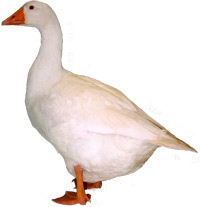
Photo: An Embden Gander at the Hannover Show 2009. 

Embden Geese are a white goose that is sometimes called the Emden (without the ‘b’) or the Bremen (usually in America). Embdens have an orange bill and legs and have blue eyes. Embdens are quite tall compared to other geese, although the Embdens in the UK tend to be a little shorter and stockier than those found on the continent.

The Embden is thought to originate from the North part of Germany. The town of Emden used to be spelt with a ‘b’ and the goose has retained this in its name in the UK. Some early publications suggest it might have some of its origins in Holland but some of the more respected Authors of the day, such as Lewis Right believed the breed to have been created in Emden, North Germany.

Embden geese do not lay very many eggs in a season, typically only 20 eggs. They will often go broody and are good sitters. Ganders can be aggressive whilst protecting the sitting goose or young goslings. Some grey feathers can be found in young first year females, typically on their back or rump but eventually, they should end up as pure white.

The Embden is called L'oie d'Emden in France and Emder Gans in Germany. They have been a popular bird to use to generate a hybrid cross for meat production across Europe. In the UK, the largest supplier of Embden Crosses is in Norfolk - Goslings from Gulliver Geese. Typically, Embdens can be crossed with Toulouse Geese or other large Geese if you want to create a good utility hybrid. During the last century, the emphasis was always on improving the goose’s weight and many of the early poultry shows judged birds on their dead weight.

Photos

View the embedded image gallery online at:
http://poultrykeeper.com/goose-breeds#sigProGalleriae05944a94f

Books

The following books are available. Links take you to the Amazon or other sellers' pages for the books.

Discussion

  • Comments / Questions? Looking for stock? Visit the Waterfowl Section of our Forum
  • Please leave us a comment below if you can provide further information on this breed.

Czech-Gander-cut-out

Uses: Utility - meat. Eggs: 10 to 25 white eggs per year.
Origin:
Germany / Czech Republic.
Weight: Gander: 5 - 5.5 Kg. Goose: 4 - 4.5 Kg.
Colours: White.
Useful to Know: Czech Geese are very similar in appearance to Roman Geese but are smaller in size. The lightest of geese useful if you are limted for space.
Photo: Best of Breed Czech Goose at the British Waterfowl Association National Exhibition 2010 owned by Denise Moss.

Czech Geese are very short and stocky and one of the lightest geese at only 4.5 to 5.5 Kg. They are a lively goose and keep active and alert. These Geese were developed in Germany but the original birds came from Bohemia, an area occupying the western two-thirds of the former Czechoslovakia, now called the Czech Republic.

The Czech Goose was standardised in 2008 in the UK. They are called Tschechische Gänse in Germany.

Photos

View the embedded image gallery online at:
http://poultrykeeper.com/goose-breeds#sigProGalleria13a9738ee9

Books

The following books are available. Links take you to the Amazon or other sellers' pages for the books.

Discussion

  • Comments / Questions? Looking for stock? Visit the Waterfowl Section of our Forum
  • Please leave us a comment below if you can provide further information on this breed.

chinese-goose-cut-out-2

Uses: Utility - eggs and meat. Eggs: 40 to 80 white eggs per year.
Origin:
Europe.
Weight: Gander: 4.5 - 5.5 Kg. Goose: 3.5 - 4.5 Kg.
Colours: Grey, White.
Useful to Know: At 8 weeks of age, the size of the basal knob can be used to sex goslings. Chinese can be very noisy and are useful as a guard dog / to alert you of intruders but usually too noisy if you have near neighbours.
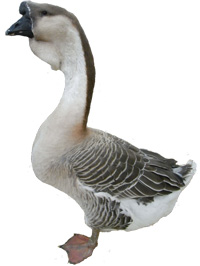
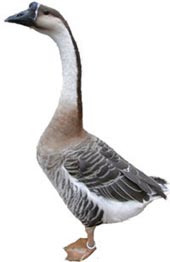
Photo: A Grey Chinese Goose.

Chinese Geese are known as Höckergänse in Germany and Oies de Chine in France. The Chinese Goose is a descendent of the wild Swan Goose. They come in two colour varieties, grey and white. The grey Chinese Geese look similar to African Geese who are also descendents of the wild Swan Goose however they are a much lighter build.

There are two distinct types of Chinese in the UK, an elegant exhibition strain that was introduced during the 1970's from America and a heavier English dual purpose utility type of bird.

Chinese Geese are quite a popular breed for their looks as well as their suitability as ‘guard dogs'. They are very alert and curious and can be rather noisy when strangers are about.

The temperament of Chinese Geese can be quite different between strains although, as with other geese, their upbringing has a lot to do with their temperament. Care should be taken with ganders if the goose is sitting on eggs as they have been known to take a strong disliking to visitors at this time! Geese are known to go broody easily as well as being good layers of eggs.

The number of eggs a Chinese will lay is again dependent on the strain. They are reasonably good layers and a reasonable strain will lay around 50 white eggs per year although some have been know to lay more than 80 eggs.

By about 8 weeks of age, the size of the basal knob can be used to sex goslings. The knob is smaller in the goose than it is in the gander.

Photos

View the embedded image gallery online at:
http://poultrykeeper.com/goose-breeds#sigProGalleria118191e099

Books

The following books are available. Links take you to the Amazon or other sellers' pages for the books.

Discussion

  • Comments / Questions? Looking for stock? Visit the Waterfowl Section of our Forum
  • Please leave us a comment below if you can provide further information on this breed.

Page 1 of 2


Like this page..?

Tip: Buy Now

Buy-NowClicking a 'Buy Now' will take you to a sellers page...