
Keeping chickens is generally considered a low-risk hobby. Still, at some point, you may decide to get a cockerel. It’s a good idea to assess a cockerel’s temperament to understand how aggressive he is, but if you have children, it is imperative to have a good-natured cockerel.
I cannot emphasise enough, how important it is to assess his character before even allowing children to go into your chicken run, supervised. This article provides some help with evaluating the temperament of a cockerel.
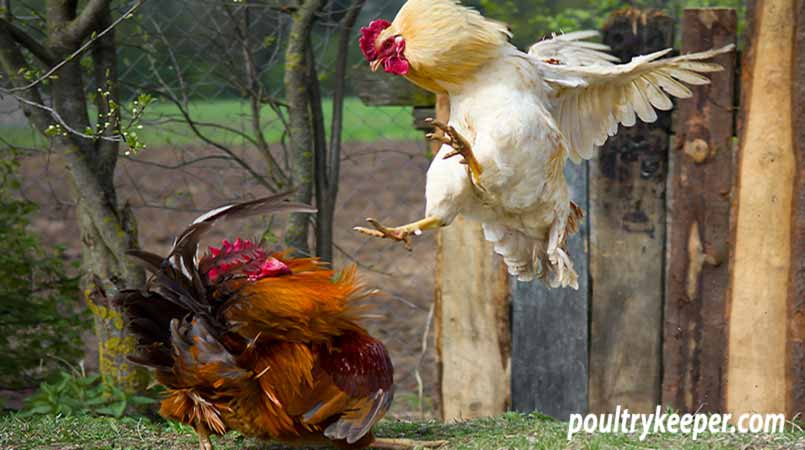
Just like you wouldn’t risk a dangerous dog with a child, you must ensure the cockerel you select is suitable to have around. A cockerel can jump a few feet off the ground, kicking out with their feet and spurs, so as well as delivering a very nasty scratch, could quite easily knock a young child off their feet or worse.
While you should always supervise children around animals, the reality is many chicken keepers, also have children and a cockerel, so continuous assessment and supervision is critical.
Continual assessment
Every cockerel I keep is being continually assessed. Since I have young children visiting our household and therefore my birds regularly, I cannot take any risks. I have put together the following tips to help you to assess a cockerel’s temperament.
Some of these things can be done before you take a male bird home, but the assessment is a continuous process and you have to monitor the situation very carefully. You will often be buying or will have hatched a young bird who isn’t yet mature and temperaments will definitely change during the breeding season.
1. Parent stock
The most important factor if you are buying or have hatched a young cockerel is to try to get an idea of the temperament of the adult stock.
If you are buying from a breeder, ask as many questions as you can. For example “Can we have a look at the father of this cockerel as he will end up looking like him won’t he?” “Is it safe for me to go into the run with him to have a closer look?” and the crucial “Is he friendly with Children?“
It is unlikely a breeder will see any harm in you asking a direct question about his parent stock but isn’t likely to tell you the young cockerel you are buying now will grow up into a great scrapper.
After all who is to know, this young, vulnerable bird hasn’t caused any harm and it is always difficult to re-home cockerels.
Male birds don’t always turn out like their father but if the genes are present in the adult stock, there is a high chance they will exhibit the same behaviour and there is a saying “like breeds like” which is often true.
2. Size
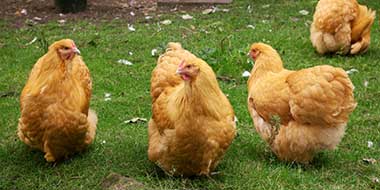
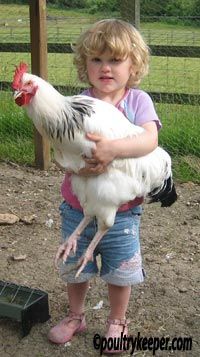
Do not be fooled by the size of a cock bird, I have had a small Pekin Bantam who left me with some nasty cuts to my leg and a huge Buff Orpington cockerel who I would take to my local school and enjoyed being picked up and hand fed by the children.
3. Breed
Like different dog breeds have different temperaments, different breeds of chickens have different temperaments. See the temperaments of different breeds of chickens for more information.
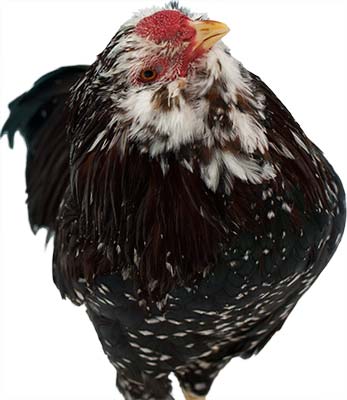
Remember, different strains within a breed can have different temperaments. I have had two different strains of Light Sussex, for example, and the cock birds were at opposite ends of the scale in terms of temperament.
4. Behaviour
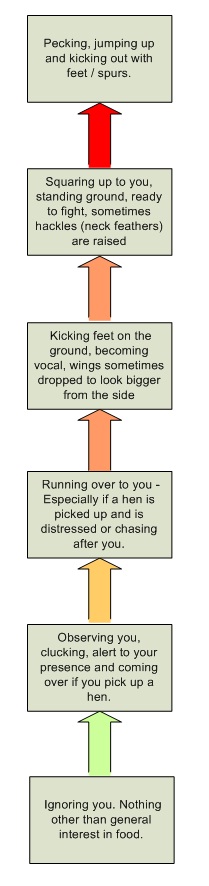
I usually imagine the aggressive behaviour of a cockerel as a ladder. Full-blown kicking and fighting is at the top and ignoring you is at the bottom.
How far up this ladder a bird will go will depend on the stimulus and the temperament of a bird. Every bird has the ability to cause damage which is why children should be supervised at all times.
A child can do things that we might not expect which could cause a bird to go higher up the ladder than normal adult behaviour would.
Ladder of aggression
The ladder of aggression shown here (aggression increases from the bottom to the top) is based on an idea by Veterinarian and Animal Behaviourist Kendal Shepherd, used for dogs.
Assessment
When you go into the run / enclosure, watch how the cockerel behaves and how far he will go up the ladder of aggression.
Picking up a hen in the run and going down on your knees to his level is a great test. Yes, he will be concerned and this sort of behaviour should be expected, if he is doing his job looking after the hens, he will be concerned about her and will probably come over and be vocal.
He will often tread his feet quickly on the ground around her when she is put down to calm her down.
Sometimes cockerels will run over to you (you are usually the source of food after all). This sort of behaviour is quite normal however chasing you out of the run after food has been left on the ground should be seen as an aggressive act.
A cockerel who chases after you like this is more likely to kick out than a bird that goes back to his hens to show them the food or skirts around you, scared to come any closer.
Often once picked up, an aggressive bird will become placid so it is always better to pick up a hen with the cockerel running free to get an idea of his temperament.
If you are still unsure, it’s best not to take any chances. You could keep hens on their own and buy in fertile eggs, change breed or find a less agressive male or think about keeping ducks!
Finally
A little disclaimer: This article has been provided in good faith and advice is presented ‘as is’. I cannot accept any liability for actions that may or may not occur as a result of you following the advice contained within this article.