
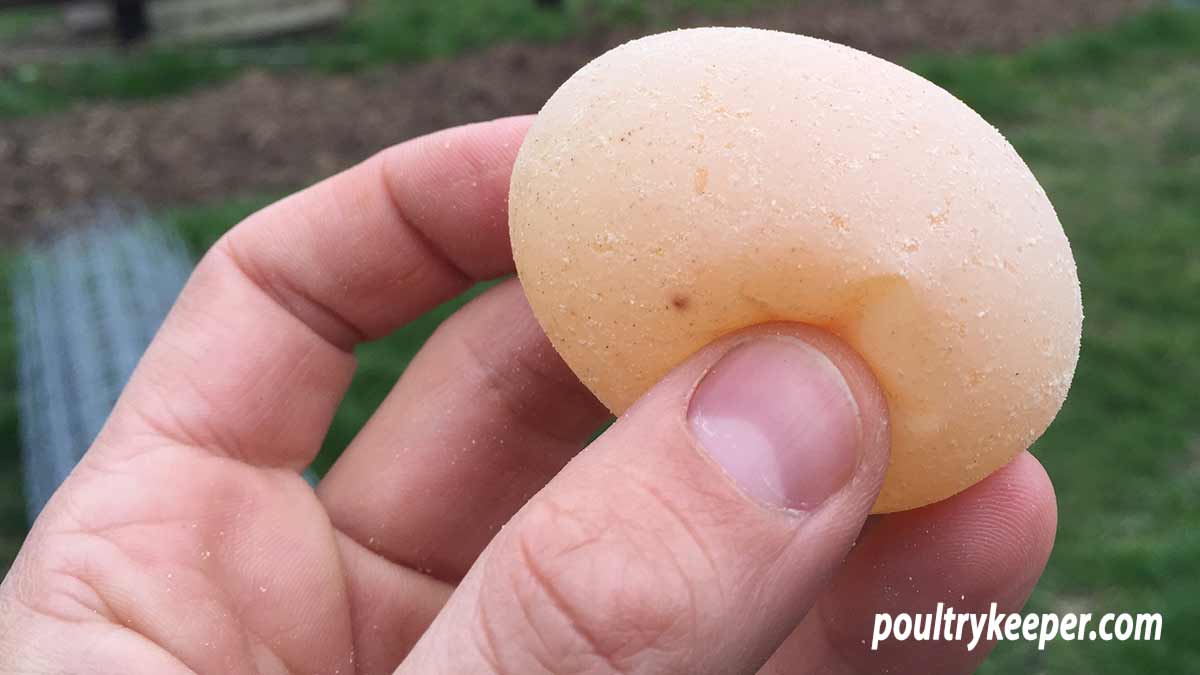
New chicken-keepers are often concerned when they find a soft-shelled egg, so this article aims to provide information about the causes of these strange eggs with missing eggshells and provides some tips to preventing soft eggs.
Soft or missing eggshells (sometimes called shell-less eggs) are quite common in older birds, especially high production hybrids / good layers, especially as they come into or out of lay for the season. A ‘soft-shelled egg’ has a membrane but no shell.
This short clip shows you the difference between a thin egg-shell and a soft egg without a shell, just the membrane:
Some causes of soft-shelled eggs
Here are some of the reasons chickens lay shell-less or thin-shelled eggs. I don’t think this list covers every situation but should cover the majority of cases.
1. In good layers
Good layers are the usual candidates for soft/shell-less eggs. For example, hybrid hens have been selectively bred to lay hundreds of eggs (it’s not uncommon for the commercial ‘brown hens’ we see to lay 320 or more in a year), and I believe they are just producing eggs faster than they can shell them. The normal ‘shelling process’ usually takes around 24 hours, and I have had hens produce a perfect egg followed by a shell-less egg in less than 12 hours.
In pullets (female chickens under a year old), sometimes an egg stays in the shell gland for too long and is often covered in excess calcium (see calcium coated shells), then the egg that follows doesn’t spend long enough in the shell gland. Again, the two eggs are laid closely together on the same day.
Having kept hybrids alongside pure breeds for many years, I’ve seen far more instances of shell-less eggs with the hybrids. Maybe we’ve pushed mother nature to the limit in our quest for more eggs?
2. Hot days
Thin eggshells or shell-less eggs can occur more frequently on hot days. This is associated with a lower food intake, and shell thickness/shell will return to normal when the temperature drops again, and your chicken’s food intake returns to normal. There have been some mentions of this in commercial farming, where they see lower intakes of food on hot days and lower shell quality.
3. Insufficient shell-forming material
This is the most obvious, but I have only listed it as number 3 because most of us these days are feeding our chickens with a modern balanced feed and our hens have some access to free-range and grit. Poor shells, however, can occur if hens aren’t supplied with sufficient shell-forming material (mainly calcium).
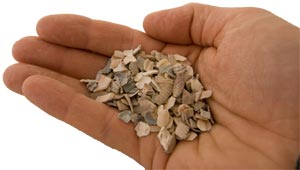
Chickens get calcium from soluble grit, often called Oyster shell grit, and this should be supplied either on its own or as ‘mixed grit’, which includes flint grit for digestion.
Another big source of calcium in a hens diet comes from their food. If you look at the ingredients on the back of layers pellets, you will see far more calcium than other feeders such as growers pellets. Fresh greens also provide hens with a source of calcium.
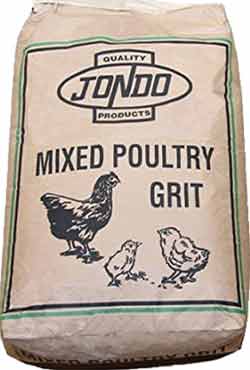
Jondo Mixed Poultry Grit
Probably one of the most popular brands of mixed poultry grit in the UK comes from JONDO.
John J. Doe & Son is a third-generation family business that has been making grit at their site, 6 miles west of Lincoln, since 1942.
A 25Kg bag may seem like a lot, but keep in mind that grit is heavy, so this is a good size for most small backyard flocks.
4. Old age
Some birds can lay more soft eggshells as they age. Again, this is particularly true of hybrid breeds that have been optimised to give as many eggs as possible during their first year, such as the Bovan Goldline, often found on commercial farms.
Once these birds reach 4 or 5 years old, you may find they start to lay eggs with soft shells. If you keep ex-batts, then our section of Rehoming ex-battery Hens has several articles, specifically for ex-battery hens and their needs.
5. Insufficient protein in the diet
Chickens need the correct level of protein in their diet as well as minerals and various other vitamins. FOR EXAMPLE, Vitamin D3 (Cholecalciferol) is used to metabolise calcium and phosphorus to form eggshells and strong bones. Vitamin D is found in Cod Liver Oil, but they shouldn’t normally need this if fed the correct formulated layers feed, are free-range and have sunshine on their backs.
6. Overweight hens
Chickens that are overweight can stop producing eggs altogether or produce lower quality eggs, sometimes with missing shells. Take a look at the breast of your birds; when the feathers are parted, you should see the skin is thin (almost like tracing paper), where the breast bone protrudes forward. If there is thick skin, or you can’t see the breast bone clearly, the chances are your birds are carrying too much fat.
Caution: Mixed Corn and kitchen scraps
Mixed corn, or 'scratch', is made up mainly of wheat with a little cracked maize (yellow in colour). Wheat typically contains 10% protein which isn't a sufficient amount for a laying hen. Maize is very fattening and hens carrying fat internally are more prone to laying problems such as prolapse and lay more shell-less eggs.
Keep corn as a treat only. A handful per day per bird is sufficient.
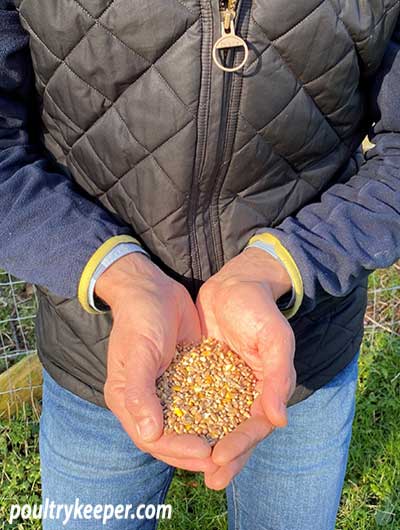
Check to see that you are feeding your chickens correctly. I only give my hens an extra handful of mixed corn on cold winter days – they can use the extra fat to keep warm.
Feeding household/kitchen scraps is technically no longer allowed by DEFRA, but if you feed ‘allotment scraps’ (where scraps have not gone into the house/kitchen), they can be a bit of a mixed bag of what a hen needs in her diet. While this is a way to save on feed costs, scraps shouldn’t exceed 25% of a hen’s diet as a general rule. Allotment scraps should ideally be boiled and then mixed with layers mash to make a crumbly mixture, so the hen is getting a more balanced diet from the layers feed, but since you’re not allowed to even pass through the kitchen with these scraps, it makes boiling them tricky!
The best way to ensure a hen is getting the correct diet is to use a balanced layers feed and then supplement this with greens and some free-range to top up with other things she needs during the peak months of egg production.
If hens can be free-range on grass or rough ground, this is much better than any vitamin drink or supplement. They will be able to pick up a lot of the extra grit, vitamins and minerals they need and be a lot less prone to health problems as well as soft-shelled eggs.
Other reasons for soft-shelled eggs
If the above doesn’t seem to be the cause in your case or soft-shelled eggs are being laid regularly, then there could be several other reasons:
- Inflammation of the oviduct (and there isn’t anything that we can do about this as far as I know).
- Calcium absorption problems (if the diet is correct and oyster shell grit is provided ad-lib, then there is sufficient calcium available, but it cannot be absorbed correctly by the hen).
- Stress. The problem usually goes away once the cause of stress is removed. Keep an eye out for bullying/feather picking, especially if it occurs around the nest boxes and you are finding the soft-shelled eggs outside of the nest boxes. Apple Cider Vinegar is good to help hens with stress.
Soft-shelled eggs laid once in a while are nothing to worry about. Hens at the start of their laying period, or have come to its end, often lay a soft-shelled egg.