
How to Get Rid Of Rats
As a poultry keeper, sooner or later, you will need to know how to get rid of rats.
A pair of rats left unchecked can produce a thousand descendants in a year! I can’t imagine how much feed they would consume, let alone the damage and disease-carrying potential.
This guide will help you to learn about rats and how to reduce the rodent carrying capacity of the environment around your chickens.
If you’ve got rats, I have shared techniques of how to get rid of them and provided advice on controlling rat populations sustainably, without toxic poisons.
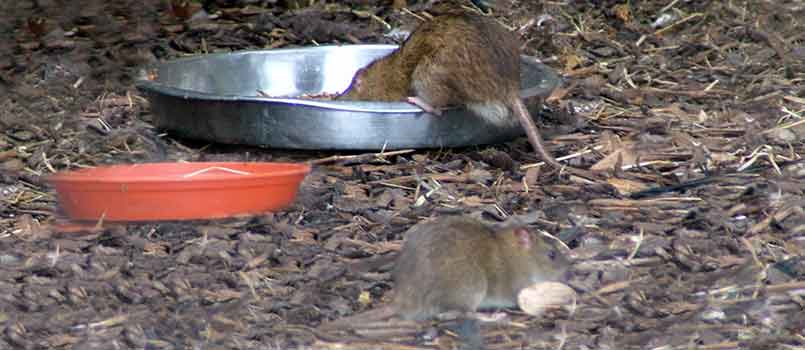
As a species, rats have been very successful. Brown rats have colonized most of the world to become the most common urban rodent. They are a real challenge to control around chickens. During my 30+ years of keeping chickens, I have had numerous encounters with them, and finally, I believe I have a non-toxic, sustainable strategy for controlling rats around chickens.
You may be thinking ‘trapping rats is notoriously tricky’, but I believe I have found a technique that works well.
First, it is essential to understand how rats behave and then follow some necessary steps, and be ready to make a few changes such as trap location and type of bait to make trapping successful.
Landowners in England and Wales are obliged to control rodents under the terms of the Prevention of Damage by Pests Act (1949). This places an obligation on owners or occupiers to control rats and mice on their property and to inform the local Council of infestations.
Local Councils have powers to ensure that rodent control is carried out and may serve enforcement notices on landowners. Councils can carry out the works required directly and charge the costs to the owner.
Rats are known to carry a significant number of diseases. In one study (Webster & MacDonald, 1995), 510 brown rats caught on farms were carrying thirteen zoonotic and ten non-zoonotic parasites.
In short, brown rats can carry a lot of nasties: Salmonella, Weil’s disease, Cowpox and Hantavirus, worms as well as ticks, lice, mites and fleas, not to mention the Plague that is still a problem in most parts of the world.
Most of these can cause serious illness in both humans and livestock.
Apart from the risk of diseases that rats can carry, they will gnaw holes in feed bins and poultry houses to reach food, and if they reach it, they will often contaminate it with droppings and urine.
In buildings, rats will cause damage to electrical wiring, which is the number one cause of electrical fires on farms in the UK.
This is why we need to know how to get rid of rats.
Mention keeping chickens to someone, and they often say how amazing it must be having fresh eggs, but many go on to ask whether I have a problem with rats.
Of course, it’s not the chickens that cause rats; it’s the shelter, food and water we unintentionally provide when keeping chickens. We increase the rodent carrying capacity of the environment by providing everything they need to survive.
It’s not just chickens either; rats are a common problem in gardens when you feed wild birds.
How can you tell if you have got rats?
What to look out for
Vigilance is the “name of the game” to prevent rats from getting a hold. Providing you keep a clean and tidy ‘ship’ they are not difficult to spot once you know the signs. The most common time of year that people notice a rat problem is as the weather turns cold in the autumn as rats seek food and shelter for the winter.
Rats need three things:
- Shelter
- Food
- Water
If we can eliminate one or more of these things, you won’t have rats. That’s easier said than done though. Often we can’t remove all food, water and shelter so we need to minimise it so that we can reduce the rodent carrying capacity of the environment.
Conversely, if they have shelter, food and water, they will multiply quickly in line with the available resources!
The signs of rats
- Rat Holes - Brown Rats will dig holes for to shelter from predators, to store their food and as a home for nesting.
- Rat Droppings - Rat droppings are a sure sign, usually found near feeding points. Droppings are dark brown and spindle-shaped.
- Gnaw marks - Where rats try to get in or under something, they will try to gnaw a hole.
- Nests - You may discover a nest. For example, it could be under a chicken house or a pile of rocks. It will be somewhere dry and well protected from bad weather. Rats will shred materials with their teeth and carry-in softer materials such as feathers and bedding from chicken houses.
Finding chewed up whole grain wheat is evidence of mice – rats leave no crumbs. While mice can also be a considerable nuisance, in my experience where there are rats, there are no mice.
Rats are most active at night, so look for rats running for cover when you lock up your chickens at dusk.
If you are using an automatic chicken door closer, you should be checking it’s working correctly from time to time anyway, so keep your eyes open for these unwelcome visitors.
It is usually easier to spot these signs of a rat infestation, rather than seeing a rat!
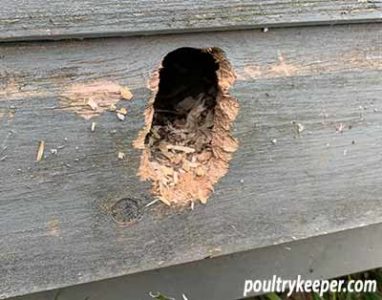
A very obvious rat hole was gnawed in the side of a chicken house where there was a feeder.
Shelter: where the rats are living?
When rats move in, they will choose somewhere for their home. They like to have at least one additional escape route or ‘bolt hole’, so you’re looking for at least two holes.
It will always be somewhere they can shelter from predators and the elements. They will also want to find the safest routes to access food and water.
Now you know this, where is ‘home‘ for your rats?
For example, a hedge next to a chicken run, or underneath a garden shed or chicken house are common places for them to make a home but consider other locations such as compost bins, overgrown vegetation, or underneath wooden decking.
Food: what are they eating?
As they establish their home, your rats will create ‘rat runs’ to get from ‘home’ to other locations that can provide them with food.
One of the biggest predators of rats is owls because they hunt at the same time that rats forage for their food. Sadly, this is the reason so many birds of prey are getting killed by eating rodents containing rat poison.
Rats prefer to find routes with cover, which is why they will run along the side of a wall or fence. Given an open space, they will go from object to object, often burrowing underneath it to give themselves additional protection.
I have seen burrows under duck baths, grit hoppers, feeders and poultry housing, pretty much anything you place on the floor can provide them with harbourage if they burrow underneath it.
Mostly, the first sign is rat holes as they seek to establish safety getting to and from food sources.
Their preference is to feed where they have a shelter– this where they feel safe.
Water: where are they drinking?
Rats need to drink water daily so must have constant access to a source of water. Again, the same rules apply about getting to and from it in the safest way. They will try to find cover to reach their source of water.
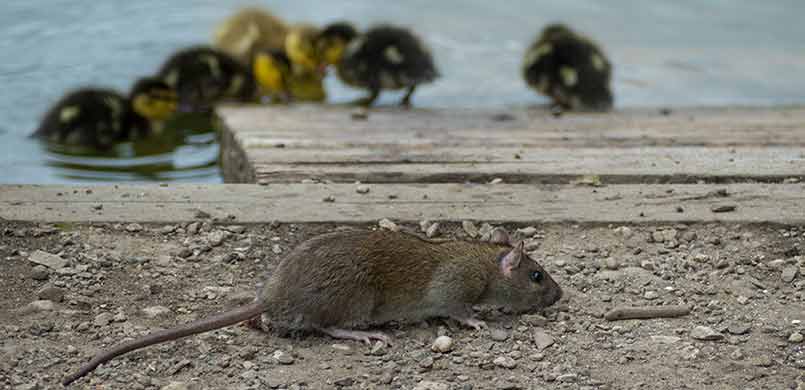
Rats need to drink water daily so need to be a source of water.
How to get rid of rats
Step-by-step
Now you know the three things rats need to survive, it will be no suprise that a big part in controlling their numbers involves removing one or more of these!
This is how to get rid of rats:
- Long-term control is only possible when you reduce the rodent carrying capacity of the environment: so we reduce shelter, food and water that rats need in as many ways possible.
- Trapping is non-toxic but will require the right bait and in the right location to get rats to use the traps. Multi-kill or catch traps are better because they can kill more than just one rat at a time.
- Poisoning causes a horrible death, but also rodenticides are toxic to wildlife and pets. Poison will only provide a short-term reduction of their populations. It is the nuclear option and I would urge you to only poison rats if you have exhausted other options or there is a danger to human life from a rat infestation.
Let’s look at this step-by-step.
Remove shelter
Rats love untidy areas, and debris gives rats places to hide. Less clutter gives them less shelter. Whatever they are using for harbourage needs removing, (or at least, reducing as much as possible). Rats don’t like to be out in the open, so they will burrow underneath and behind things.
The most common problem is having rats burrow underneath poultry houses. The best solution is to raise them off the ground, or if this is not possible, for example with a shed, you will need to build a concrete base underneath it.
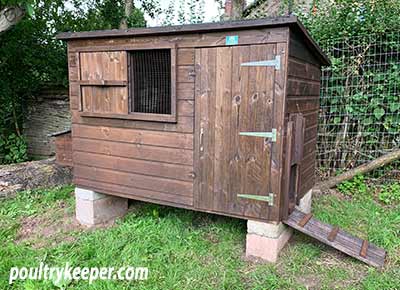
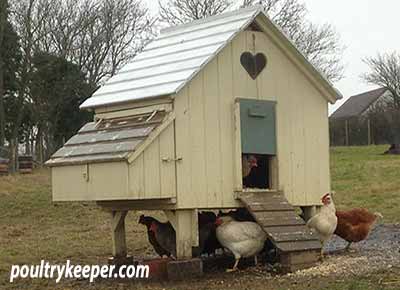
Raise chicken houses off the ground using blocks or wooden legs. Put sheds on concrete bases.
You can have wooden legs on your coop or lift it off the floor onto concrete blocks.
I have found raising it enough for your birds to walk underneath also doubles up as a shelter for them. My chickens will prefer to stand under their house during wet weather rather than going inside as you can see in the photo above.
Other problem areas I have encountered are with concrete slabs I’ve placed on the ground to level feed and water containers. My feeders are out in the open, and having a burrow underneath gives the rats somewhere to shelter in a hurry if they sense danger.
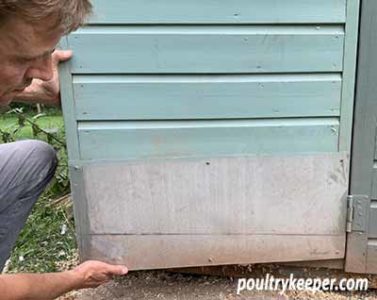
A metal kick plate on the bottom of a door.
Block their holes with stones, or balls of squashed chicken netting, if rats are finding a way underneath wooden doors, a metal plate can be screwed on to the bottom of the door.
A study by Lambert (2003) showed that rat-proofing buildings and good hygiene, such as removing rubbish and other harbourages could be as effective as poisoning with long term benefits.
Keep a tidy yard and rat proof everything you can, and you’ll have far fewer problems with rats!
Remove food
First of all, an ‘easy win’ is to stop rats from getting in to your feed stores. Metal feed bins or dustbins can keep rats out, or you could rat-proof a shed to use as a feed store.
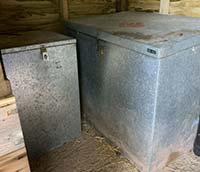
Tip: Use A Galvanised Steel Storage Bin
Rats have an excellent sense of smell and will chew holes in plastic dustbins or containers to get to the food stored inside. Use galvanised steel storage bins like this one. They are weatherproof and stop rats from reaching your expensive chicken feed.
A more difficult problem is preventing rats from accessing food that’s intended for your birds. Feeding layers pellets ad-lib in open feeders is practical but presents a problem when there are rodents.
As a minimum, if you have an open feeder then place it out in the open where rats will feel uncomfortable and are more exposed to predation. You will need to put your feeders down 2 or 3 times during the day for your hens to feed and ensure they are removed at night.
The only sure way to stop them getting your chicken food is to use a rat-proof feeder. These prevent rats from taking food but still allow your chickens to feed.
Rat proof chicken feeders
By now, you’ll understand that removing the food rats are eating is essential if you are to reduce the number of rats around your chickens. I would say this is even more important than a rat trap because rats will continue to feed on your chicken food given a choice between that and the bait in your trap!
Rodent proof feeders are an easy way to ensure rats can’t get to your expensive chicken feed, once the chickens are used to them, they work well.
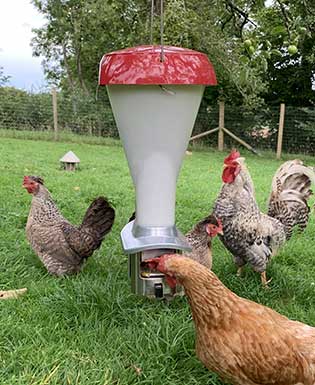
A rat-proof treadle feeder has a lid that opens when a chicken stands on the treadle plate. It is hinged so that their weight lifts the food cover, allowing access to the food.
You need to train your chickens by leaving the feeder lid open, then a few days later, you allow the cover to move a little when the stand on the treadle plate. Once they get used to the movement, you can put it into full service with the lid closed.
Rats are not heavy enough to open the lid so only your chickens can get to the food.
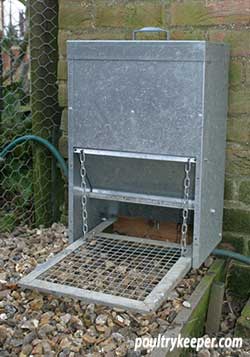
One of the best value treadle feeders I’ve found is the Voilamart Chicken Automatic Treadle feeder. Made from aluminium, it doesn’t rust.
I have two other ‘branded’ galvanised steel treadle feeders that were over twice the price and both have leaked and started to corrode inside as well as underneath after just a few years of being outside.
When removing food that rats have been feeding on, don’t forget to omit organic food waste from compost heaps and to clear away wild bird seed debris; these are two other familiar sources of food for rats in our gardens.
Finally, I think most people have wheelie-bins with a lid these days but if you don’t, make sure bin bags are put into sealed bins and not left out for rats.
Roamwild
Rat Proof Feeder
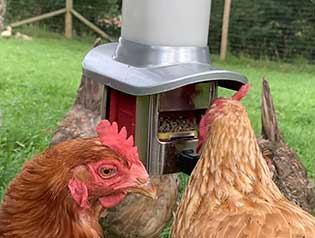
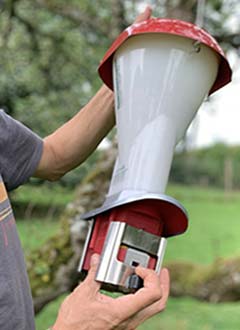
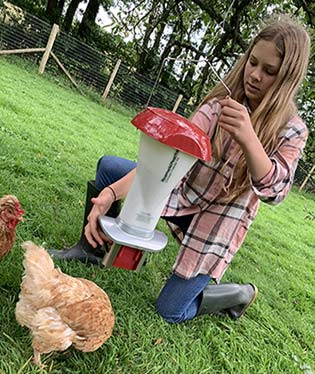
For a small number of chickens, the Roamwild hanging rat proof chicken feeder is one solution.
It must be hung away from the sides of your run, at a height where chickens can reach it. Rats need to stand on their back legs to get to it.
They hold onto the feeder to get to the food, and their weight pulls a spring-loaded shutter down, closing off access to the feed.
Remove water
Rats need continuous, easy access to a water source. Unlike mice, they have to have water daily. It’s not always possible to remove all water sources (for example, we have a duck pond and stream near our chickens).
Remove water drinkers at night if you suspect rats, so the chicken run is less attractive for rats. Your chickens will benefit from having fresh water every day.
Trapping rats
While mice are relatively easy to trap because they will investigate new things we add to their territory, rats are a completely different story. This is one of the reasons I have written such a long article on how to get rid of rats.
Rats are neophobic, which means they are afraid of new objects appearing in their territory.
This neophobia makes trapping rats much more difficult.
I have placed traps, and watched rats walk around them for days, pulling my hair out, then moved the trap and after a couple of days caught ten rats in a row.
It can be infuriating when a rat trap doesn’t work. They DO work, but you’ll need to work out WHY they aren’t working. You’ve guessed it, I have some tips coming up!
It's a trap!
If you were a rat eating from a big open chicken feeder, would YOU go inside that weird-looking thing that appeared a few nights ago?
Would you be tempted to try that new food that's in there when all your life you've been doing just fine with the chicken feeder? No way! You're a smart rat!
OK, I'm getting carried away here, but I think you understand what I'm saying. Neophobia is a big thing for rats, it takes them some time to get over new things.

- Location: rats need to feel safe from predators. Place a trap underneath or behind something. Underneath a hedge, chicken house, decking or shed, behind a piece of wood up against a shed. I’ve even had success with cage traps tucked underneath a concrete slab raised on four bricks.
- Not all locations work: You can set ten traps, and some will not be touched, while others will catch time after time. What seems like the best location doesn’t always work.
- Be patient. With rat’s neophobia, it can take 10 to 14 days before they will go into a trap.
- Remove food rats have been feeding on. We want them to be hungry, so they are more willing to go into a trap. They will always feed on the safest source of food. If you remove chicken food, often rats will start to take eggs, so collect them regularly.
- Try different baits: while there are some things rats find irresistible (list further below) sometimes it’s better to use the SAME food that they have been used to feeding on.
- Give them a free taster session: Leave pea-sized blobs outside of your trap and around the surrounding area. Once they start taking these, it will build their confidence to go for the bait in your trap.
More sophisticated traps like the Goodnature A24 (more on this below) will come with baited test cards. You place these in potential trap positions to test the interaction you get in different trap locations.
This helps you with placing the trap, but also, the chocolate formula that is used inside the trap as bait is the same so you’re offering the free taster session at the same time.
GoodNature A24
Rat Trap
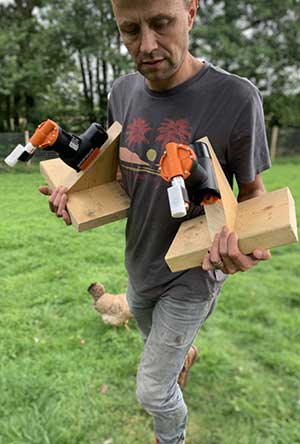
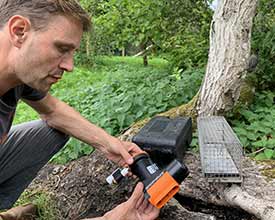
My most successful rat trap! The Goodnature A24 is a humane, non-toxic, multi-kill trap.
Detector cards show you where to place it (where rats feel safe to feed)- powered by CO2, a hammer fires when they enter the trap.
Bodies are often scavenged from underneath by birds of prey or cats, so the counter tells you how often the trap has fired.
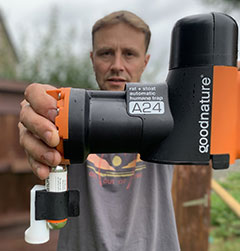
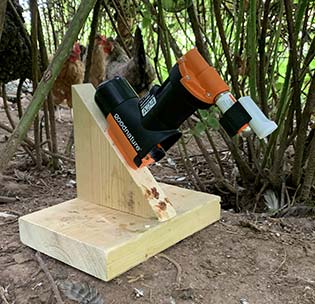
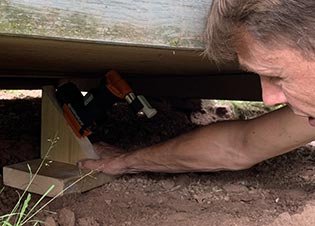
I use two humane A24 traps made by Goodnature to get rid of rats around chicken runs without using poison which can kill owls and other birds of prey. Powered by a small CO2 canister and is self-resetting, it can kill up to 24 rodents one after the other on one cartridge of CO2.
What is interesting is there is a big contrast between reviews on Amazon, some saying it did work and others saying it didn’t.
For the first two weeks, I wasn’t catching rats, so I did a lot of research on trapping rats, and in conclusion, the trap position and bait is crucial.
If you placed multiple traps around your backyard with the same bait, some would be left untouched while others would be heavily used. The detector cards that come with the trap will show you where the rats will feel safe enough to feed.
A second important point is making sure there are no other food sources available. I have had rats start eating eggs after installing a rat-proof feeder.
Snap traps
Spring or snap traps are single kill traps and will need to be checked daily.
The same rules apply about setting them in sheltered locations and finding the right bait. It is easy for these traps to be set off by non-target species, including your chickens, so make sure they are covered over or in ‘bait boxes’ where your birds cannot get to them.
I have used this snap rat trap and snap trap box for several years now. I place a few in different places with different baits.
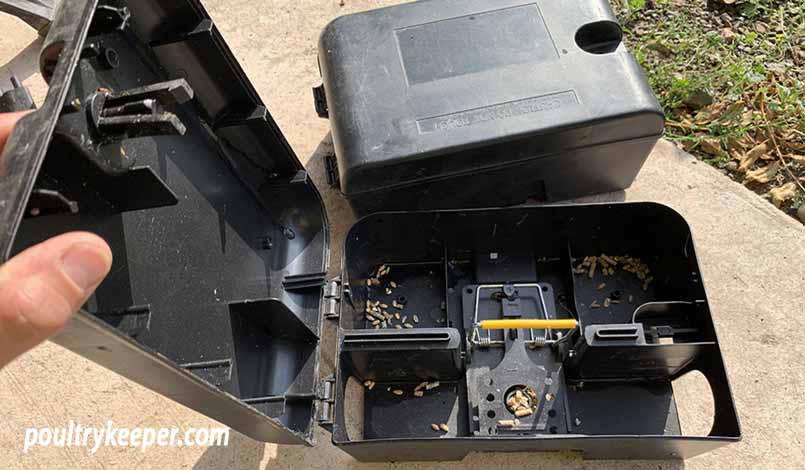
Rats will eat most things, but their preference in the wild is to eat a small amount of a wide variety of foods. In the wild, they prefer fruit and grains, seeds and nuts.
What will work in a trap varies, so be sure to try different baits. For example, rats in towns will have had a wider variety of foods than rats in the countryside.
If rats have been feeding on the same food for many years, for example, a farm grain store, they may avoid other foods.
The most effective baits to trap rats are:
- Peanut butter
- Chocolate
- Bacon & ham
- Hot Dog sausage
- Tinned Tuna/fish
- Dried fruit
- Wheat and chicken feeds (probably familiar to them!)
Cage traps
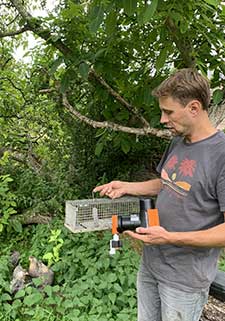
Live catch cage traps are also useful, but you have to check them regularly and be able to dispatch the rat humanely when you catch it. An air rifle to the back of the head will kill instantly.
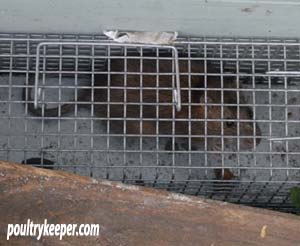 Handle the trap with care; rats can bite if confined and a finger comes near!
This cage trap on sold on Amazon is better than mine shown here because it has a solid top which makes the rat feel safer entering it and also stops it trying to bite you.
I do not recommend releasing rats in a new location. Firstly, you need to drive several miles away from home to ensure they aren’t going to come back, but secondly, it’s likely to end up becoming a problem for someone else nearby.
Considering most of the time, you will have a dozen or more rats to remove, rehoming them is not a practical method, in my opinion.
Natural predators
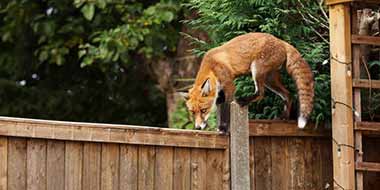
Foxes eat rats. If you have a good-sized chicken run, you can use an electric fence to protect your chickens. The foxes will learn to respect the fence and won’t trouble your chickens, but they will do an excellent job of keeping on top of the rat population.
I am a real fan of electric fences for chicken runs so that you can live in peace with the local foxes.
If you have space, erecting Barn Owl and Tawney Owl nestboxes near your chicken run will also help.
Not applicable to the UK, but in the US and other parts of the world, snakes also eat rats, and some can be beneficial for controlling rodents. Snakes also eat chicken eggs and chicks, so you will need to know how to keep snakes out of your chicken coop.
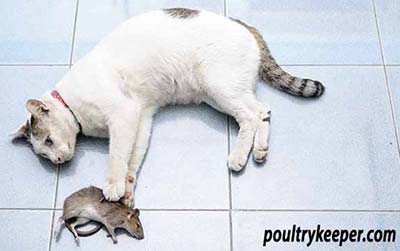
Cats can also catch rats, although there is a lot of individual variation between cats as to whether they will take on an adult rat. If possible, look for a cat that displays hunting behaviour or is known to hunt.
Other techniques
What else can get rid of rats?
You can shoot rats with a .22 Air Rifle. It’s time-consuming and for a lot of rodents, doesn’t reduce the population fast enough. You will need to ‘zero’ the rifle for the range and try to shoot the rats at this range.
The pellet travels in an arc to the target, so if the distance is different from the ‘zero’ of your rifle, you must compensate with where you aim.
Electric rat zappers also work, although when I tested one, I found it gobbled up batteries rather quickly and needed to be kept dry.
Any dirt or moisture across the plate (which has a high voltage on it) tends to cause leakage to earth, which in turn caused the batteries to go flat even faster.
If you have a good electric rat zapper, please get in touch so I can try it out and share my experiences here.
Rat poison
If all else fails
These days, with sophisticated, non-toxic, humane rat traps available, unless you aren’t able to control large numbers of rats, or they are endangering people, then I believe rodenticides should not be used.
That’s quite a statement I know when rat poison is so good at killing rats and is widely used, but rat poison kills more than just rats. It is toxic to most birds as well as other wildlife, farm animals and our pets.
I used to use rodenticides until I met a local birdwatcher who educated me on the dangers of poisoning our local wildlife. Common Shrews and Field Voles will eat rat poison which in turn results in birds of prey such as barn owls, buzzards, red kites and kestrels eating the poison.
The latest research tells us that rat poison is killing many different species of non-target animals, especially our birds of prey. You only have to Google “Rat poison killing birds”, and there are many pages of articles including this one from the National Environment Reseach Council.
Any veterinarian you speak to will be able to tell you about family pets that have been poisoned by eating a poisoned rat or mouse.
I also said rat poison is good at killing rats, but I didn’t say it was a humane way to kill rats. The rat, as much as I dislike having him around, will gradually bleed to death internally when you use anticoagulant poisons.
Anticoagulant poisons prevent the assimilation of vitamin K1, one of twelve factors that cause blood to clot.
Rodents eat anticoagulant poisons gradually until they reach a lethal dose after which, there is a time delay of about three days while they are using up all of the vitamin K1 from their body.
Once blood is unable to clot, there can be widespread bruising, blood in the urine and bleeding into body cavities. If bleeding is sudden, there will be cardiovascular shock and death.
Common anticoagulant rodenticides you will find include diphacinone, brodifacoum, difenacoum, warfarin, chlorphacinone, and bromadiolone.
No, they are not humane. Cornell Wildlife Health Lab’s page on Rodenticide Toxicity says the clinical signs of non-anticoagulant rodenticide toxicity include: rapid onset of seizures, muscle tremors, limb weakness, ataxia, neurologic symptoms, respiratory paralysis, anorexia, nausea, vomiting, diarrhoea, and lethargy.
Choice of rat poison
If you are going to use poison, then choose the right type and use it as directed on the packet.
Do not put poison down as a preventative measure when there are no rats since this is the way secondary poisoning occurs.
Most rodenticides are anti-coagulant pesticides. These can be split into first-generation rodenticides and newer, more toxic second-generation rodenticides.
Although some other products exist based on natural substances, eliminating the risk of secondary poisoning, I found limited evidence to show these compounds are effective in dealing with practical situations.
First-generation rodenticides are preferable because they significantly lower the risk of secondary poisoning, and I would urge you to consider these poisons unless you are in an area where resistance has developed in the local rat population.
First-generation rodenticides
First-generation rodenticides have active ingredients chlorophacinone, warfarin and coumatetralyl
If you are concerned about other animals eating the poison either directly or indirectly (by eating a poisoned rat, for example), then choose a multi-feed bait.
These require a few good meals of the bait before it is effective and also has an antidote (Vitamin K) that can be given by a vet should the need arise up to a few days later.
Caution when handling rats
Finally, remember handle rats with disposable gloves on – they can carry some nasty diseases. I would never have believed this, but we had a local farmer pick up a dead rat in his yard, and contracted Weils Disease. He died in hospital a few weeks later. It’s severe when things go wrong.
Be extremely careful when handling dead rats. Always wash your hands with soap after handling traps and other items that might have had rats touching them.
With a proper control plan in place, using the right methods, it is possible to control rats around chickens and your back yard. Still, it requires some thought and planning and ongoing observation to put proper controls in place, before their numbers get out of control.
I hope that this article has given you a good idea of how to get rid of rats.