
 Uses: Exhibition, originally as decoy ducks for traps.
Eggs: 50 to 150 White Eggs.
Origin: Most probably Asia before arriving in Holland.
Weight: Drake: 600 – 700g, Duck: 500 – 600g.
Classification: Call.
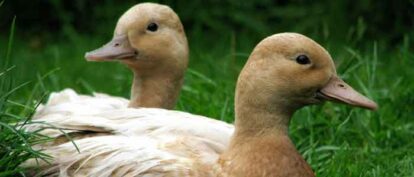
Useful to Know: Call ducks, despite their size are the noisiest ducks. Calls require low sided trays and bowls for drinking and bathing.
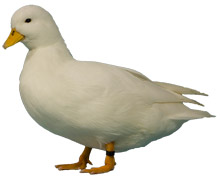
Photo: A white female Call Duck.
The Call duck or ‘Decoy’ as it was known then was one of just four ducks in the British Standard in 1865. It was standardised in Mallard and White varieties. Mrs F. Blair wrote in “The Henwife” in 1861 that “there is not a great variety in our domestic ducks; only three distinct exhibition breeds exist, viz. the Aylesbury, Rouen, and Buenos Ayres or East Indian” and Lewis Wright quoted this in his Book of Poultry in 1873 and said that her list “would be twice as long now” and the breeds he subsequently described didn’t include Call ducks so it is surprising that they made it into the Standard in 1865!
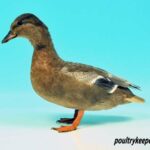
After the 1865 standard, Call ducks were left out of subsequent editions and only had a mention as ornamental ducks in 1954. It was 1971 before the Mallard (or Brown as it was called) and White varieties of Call entered the standard again and 1982 before the Blue Mallard (or Blue Fawn), Mallard Pied and Silver were added. A few more varieties were added in 1997, the Apricot Mallard, Bibbed, and Magpie. The current 2008 edition of the British Waterfowl Standards has no less than 17 colour varieties.
The exact origins of the Call are unclear but it is thought they would have been imported into Holland from Asia. The Dutch bred Decoy ducks to be used in large wildfowl cage traps and they were intentionally bred to be vocal to attract the wild ducks into the trap. What worked in Holland also worked in Britain and Call ducks (or Decoys as they were called) were also used here and in America for the same purpose.
Keeping Call Ducks
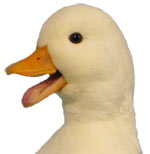 Call ducks are easy to keep although rather talkative and due to this, might not be suitable for every back garden that has close neighbours. They can be mixed with other ducks with care although they need shallow containers to be able to reach water so half size buckets that are suitable for other domestic ducks are too big for Calls. Under-bed storage containers make a good pool for them to swim in with a couple of bricks on the sides to climb in and out. These can be moved around to save wear and tear on the grass. Calls are a favourite amongst children due to their size, ability to tame and ease with which they can be handled. Call ducks, like other ducks will need to be kept secure from predators. They can also fly very well and there has been many an owner who has let their new Calls out on returning home to see them take off. Clipping the primary feathers of one wing or netting their run should stop this and once they have settled in and are happy, there is usually no need for further clipping.
Colour varieties
The Call Duck Association website provides the full Call Duck Standard together with information about most of the colour varieties. The British Waterfowl Standards referenced below (under “Books”) is available via the link. This contains excellent information and colour photos of some of the newer colour varieties and for its very reasonable price, it is worth buying a copy.
[one_half][callout style=”lightblue” title=”British Waterfowl Standards 2008″ centertitle=”false” align=”left” width=”100%”]Mallard and White were admitted in 1865, Blue Mallard, Silver and Mallard Pied in 1982. The Apricot Mallard, Magpie and Bibbed in 1997 and the Blue Silver, Apricot Silver, Mallard Dusky, Khaki, Blue Dusky, Black, Chocolate and Yellow Belly in 2008.[/callout][/one_half]
[one_half last] [callout style=”darkblue” title=”American Standard of Perfection 2010″ centertitle=”false” align=”right” width=”100%”]The Gray and the White were admitted first to the American Standard of Perfection in 1874 followed by the Bibbed Blue in 1977. The Snowy was admitted in 1982, the Buff and Pastel in 1996, Butterscotch in 2004 and Chocolate in 2007.[/callout][/one_half]
[clear]
The British Waterfowl Standards 2008 has 17 colour varieties of Call Duck. The American Standard of Perfection 2010 by contrast has just 8 varieties.
The Australian Call
Although the Australian Call duck is similar in appearance, the Australian Poultry Standard Committee cited evidence that it was an independent breed, developed in Southern Australia by Hamish Russel from mutations of domestic Mallards. The Australian Call is larger than Call ducks found in the U.K or U.S. The breed was renamed in the 2nd edition of the Australian Poultry Standard 2011 from the Call Duck to the Australian Call.
Photos


Books
The following books are available. Links take you to the Amazon or other sellers’ pages for the books.
- The Domestic Duck – C. & M. Ashton – P.22
- British Waterfowl Standards 2008 – P.129
- British Poultry Standards 2008 – P.393
- American Standard of Perfection 2010 – P.341
Breed Clubs
Articles
- Keeping Call Ducks by Wendy Thompson
Discussion
- Looking for stock? Visit the Waterfowl Section of our Forum
- Please leave a comment below if you can provide further information or have a question about this breed.